
The Loctite HB X adhesive has been part of Henkel’s range of products for six years. “It was the first of its kind at the time and a truly groundbreaking product when it was launched. It changed the cross-laminated timber industry in many ways and opened up new avenues and chances for timber construction,” Olga Golgor, Head of Sales Europe at Henkel, says. “Our Loctite HB X adhesive impresses with its excellent performance properties, thanks to which there are almost no limits in timber construction. After a long and successful development phase, its successor product, the Loctite HB XE, is now ready for the European market.” When asked about the target group for the new series, Golgor states that the adhesive is interesting for “both existing and new customers, basically for everyone who produces CLT and glulam and carries out projects in Europe. After all, we developed the HB XE specifically for the requirements of the European market.”
Test phase passed with flying colors
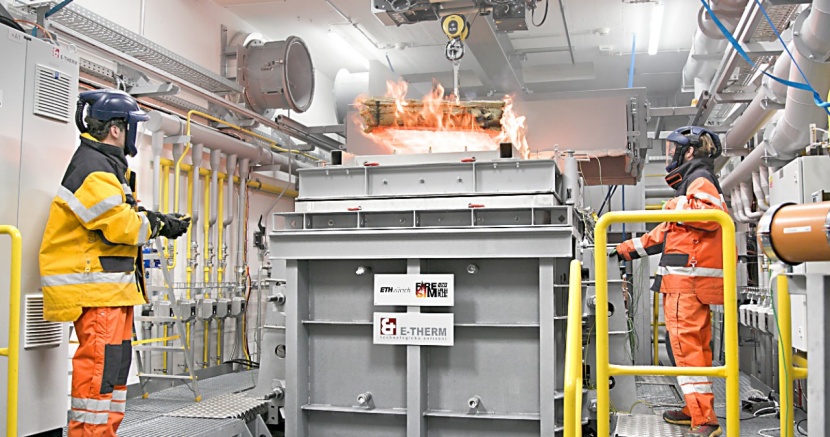
Withstands even extreme fire conditions: The new adhesive formulation for cross-laminated timber was extensively tested in the modern fire laboratory at the ETH Zurich © ETH Zurich
During the approval phase, the new Loctite HB XE was put through its paces in the fire laboratory at the ETH Zurich. The new adhesive received top marks and successfully demonstrated its high performance in the fire simulator. This is also confirmed by Prof. Dr. Andrea Frangi, Professor for Timber Structures at the ETH Zurich and Chairman of the Eurocode Standardization Commission: “With our new furnace at the ETH, we can test the performance of timber construction elements and adhesives in the event of a fire under the best possible and most realistic conditions. For Henkel’s new XE series, we now have a very good assessment basis which has been verified in experiments.”
The fire properties of the Loctite HB XE are comparable to those of the established HB X series, which “has proven its excellent properties in countless fire tests in furnaces around the world”, as Henkel states. During the fire tests in Zurich, the requirements defined in the Eurocode 5 norm were met, proving that the adhesive has a linear charring rate of 0.65 mm/min – the same rate as that of mass timber.
“By choosing our product, both manufacturers and users have the certainty that the adhesive meets all the requirements of the Eurocode 5 norm and that no additional fire tests need to be carried out,” Gordian Stapf, Certification Manager at Henkel, confirms. “In the past few months, we have also successfully completed practical tests together with long-standing partners. The HB XE has proven its suitability for industrial use, and our customers can use it as usual from day one,” Golgor adds.
In the fire test, we were able to ensure that our new Loctite HB XE maintains the required adhesive integrity in the event of a fire according to the Eurocode 5 norm. This proves that the adhesive has the same linear charring rate as mass timber.
Improving what is already good
According to Henkel, the switch to the Loctite HB XE is no problem for those who have used the Loctite HB X in the past. “The further developed adhesive can be integrated seamlessly into existing production processes,” Stapf emphasizes, and Golgor adds confidently: “The real upgrade is in the application. In terms of handling, the XE series is comparable to our popular HB-S adhesives. This means that application-related disadvantages are a thing of the past, and no compromises have to be made when it comes to performance.” Henkel states that the new XE series even outperforms the HB-S line in terms of application technology. “We were able to further optimize the ratio of open time to pressing time with the HB XE series, which offers our customers additional advantages in production,” Stapf confirms.
The selection of chemicals used has also been further improved in line with the highest ecological standards. “None of the ingredients of the new adhesive series is on the list of banned ingredients of the Nordic Swan Ecolabel for cross-laminated timber,” Stapf tells us. The Holzkurier was informed that Henkel also plans to offer a bio-based version of the new product in the future.
Leveraging “wasted” raw material potential

Less wood, more building: Henkel’s Loctite HB XE enables the use of linear models in fire safety calculations, making it possible to build slimmer and taller buildings while saving valuable material © Henkel
The thorough tests, calculations and models created in accordance with the Eurocode guidelines enable civil engineers and timber construction engineers to use linear charring rate calculation models. “For our HB XE adhesive, the proof of fire safety no longer has to be based on the step charring rate calculation model, but can be calculated in a linear way. On the one hand, this makes it possible to build taller and slimmer buildings. Above all, though, we create a substantial wood saving potential, as the necessary generous safety factors no longer have to be taken into account in the calculation. In addition, there is no falling off of charred layers, which is a prerequisite for many projects,” Stapf explains and adds: “Of course, fire safety is not the only crucial factor in component design and dimensioning. However, many customers tell us that, especially starting with fire resistance class R90, fire safety can have a negative impact on the design and dimensioning of construction elements. Thanks to the linear calculation model, it is now possible to get the maximum out without having to resort to additional safety factors due to threshold values in building standards and norms. This is a great additional advantage for all structural engineers and architects.”
“Given the numerous fire tests which were carried out, our Loctite HB X served as reference adhesive for the new Eurocode 5 norm. It is all the more significant that we now achieve the same performance values with the further developed HB XE, and also managed to greatly improve application technology. Thus, our customers benefit from the advantages of the new series in their production as well,” Golgor concludes.


