
With the commissioning of the CLT plant in 2022, Holzwerke van Roje increased its vertical integration at its site in Oberhonnefeld Gierend/DE and made a long-held plan a reality. “The idea of further finishing our lumber has been with us for a long time. Glulam and solid structural timber weren’t suitable, though,” managing director Gerhard Hauschulte explains. With the market maturity of CLT, the production of which also offers excellent synergies for the existing sawmill, the company finally found the right product.
In addition to the CLT plant, Holzwerke van Roje operates a sawmill and planing mill as well as a pellet production facility at the site, which is located about an hour’s drive southeast of Cologne. The cutting capacity is up to 450,000 m³ of log wood per year, and pellet output totals 80,000 t a year. Hauschulte estimates that in CLT production, around 80% are used in-house. The CLT plant has an annual capacity of 75,000 m³, with output expected to reach approximately 50,000 m³ this year. The company employs a total of 200 people, 60 of whom work in the CLT plant. In addition to spruce, pine, larch, and Douglas fir are also processed in Oberhonnefeld-Gierend.
Established supplier
When selecting the joinery machines, van Roje opted for the tried-and-tested solutions of well-established manufacturer Hundegger. “Of course, we looked at other suppliers, but Hundegger’s coherent plant design, combined with their Cambium software, ultimately convinced us,” Hauschulte recalls. The manufacturer’s numerous reference projects further reassured the managing director: “Hundegger is an expert when it comes to timber construction. With a project of this scale, there was no room for experimentation,” he emphasizes.




One-way production
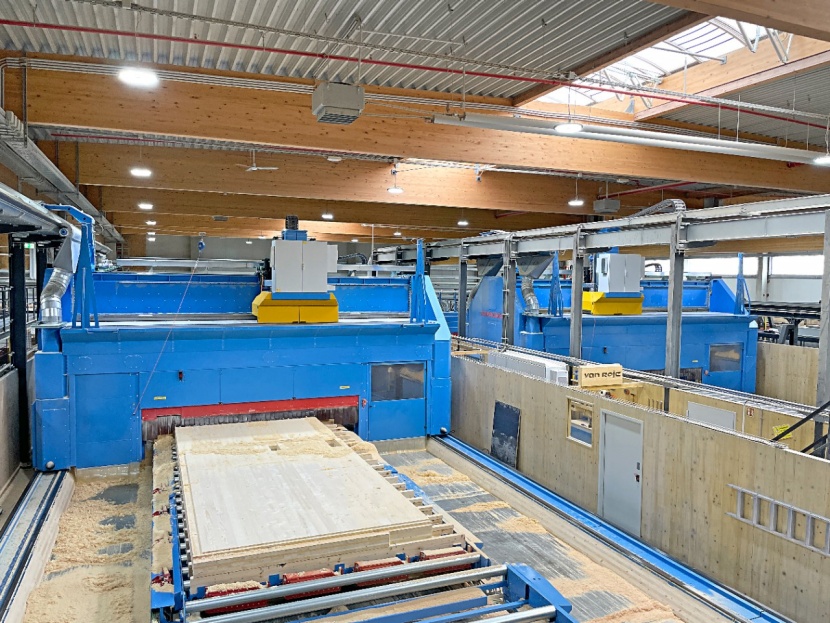
All work steps up to loading are done without an overhead crane. This was made possible thanks to a standardized flow system with a high degree of automation. An 11-t heavy-duty lift transports the raw panels to the upper floor, where an employee does a first quality check. Next, a crosswise conveyor transports the panels to the Hundegger UFA-Industry 3600. A tilting device aligns the elements along the stop. The longitudinal alignment inside the machine is done either automatically or manually. At van Roje, the machine operator handles this step most of the time. A laser assists in the precise positioning of the panels.
The UFA-Industry 3600 processes the elements from below as well as along their four edges. “We primarily use the machine for leveling,” Hauschulte tells us. In addition, rabbeting and finger milling cutters as well as two 1.8-m deep drilling units are available on both long sides.
After this step, a shuttle transports the panels to a turning device, the patching station, a grinding machine, or directly to the machine for further joining. “Since the UFA already processes the elements from below, we only need to turn about one fifth of the panels on the two PBA Industry machines when further joining them,” Hauschulte explains. “Without the UFA, this percentage would be much higher, and the utilization of the downstream machines would be a lot lower,” Jonas Volk, head of joinery, emphasizes.
High-performance duo
Two identical PBA Industry panel processing machines are available for the downstream processes. The core components are the powerful 63-kW five-axis units with continuously variable speeds up to 12,000 rpm. An optional configuration with two spindles is also possible. “Since the panels are already formatted, we don’t need parallel processing. In fact, we would only save some time when changing tools,” CLT plant manager Dennis Rott explains.
Each machine has space for 35 tools and can process panels that are up to 3.5 m wide, 16 m long, and 350 mm thick. Larger milling heads are located outside the magazine due to space constraints. Elements are analyzed before every processing step. The machine software automatically corrects any misalignments. The PBA Industry machines are also equipped with automatic suspended dust extraction. When the finished CLT elements leave the machines, they are cleaned again. A system of brushes and nozzles makes sure that even cuts and drill holes are dust-free.
A special feature in van Roje’s production: A conveyor belt removes panel cutouts that are longer than 75 cm along with the rest of the material and places them on a second shuttle. A vacuum lifter then picks up the window and door cutouts and transfers them to the specially developed CLT recycling system. The finished elements are transported by shuttle to the loading area. “Our production flow is unidirectional. For this system, which has no real buffer areas, the combination of UFA and PBA was ideal. The interfaces between the machines from Minda and Hundegger have to function perfectly,” Hauschulte emphasizes, highlighting a key requirement the two main suppliers had to fulfill.
Service as a key priority
“We appreciate Hundegger’s pragmatic and solution-oriented service. Problems are analyzed quickly and usually resolved just as fast,” Rott says. Another advantage is the Cambium software thanks to which CAD data can be easily imported and, following approval by the customer, directly converted into machine data. “The software makes suggestions on processing, which can then be further optimized using various tools,” Volk explains.
Increasing complexity in joining
“Since we launched our CLT production, the requirements for and complexity in joining have increased considerably. Our capacities are reaching their limits, which is why we are sometimes working three shifts in joining,” Hauschulte tells us. For this reason, the company is already considering building a new hall that would house another joinery machine and offer space for further finishing processes.


