
Pinning down USNR to one mechanical engineering specialization is almost impossible. From log yards to finished timber products, the US-based company is present throughout the entire wood industry, providing turnkey production lines around the world.
In Spokane located in the northwest of the USA, the mechanical engineering specialists started implementing their first cross-laminated timber project in 2018. The plant, which was commissioned by Katerra, was taken over by Mercer International for about USD 50million in the summer of 2021 after Katerra‘s insolvency. Just two months later, production was resumed and Mercer‘s first CLT panel rolled off the USNR press.
An up-and-coming market
While in Europe, CLT has been established for years, in North America the material is still in its infancy in many places. When talking to industry insiders and wood industrialists, however, a great sense of optimism becomes palpable. New players are constantly entering the market, causing the industry to grow more and more. "In the field of sawing technology as well as in the further processing and optimization sector, we have already been established for many years. Now we are noticing that also cross-laminated timber orders are steadily increasing," Michael Sampson, marketing manager at USNR, told Holzkurier during this year‘s Mass Timber Conference in Portland.
Successful showcase project

The grading line from USNR quickly and efficiently classifies the incoming lumber © Raphael Kerschbaumer
In the halls of the 22+ hectare facility, USNR is the main machinery supplier. First, every board passes through the grading line from the machinery specialists from Washington State. Once graded according to quality and strength, the lumber is brought into one of a total of 30 sorting boxes. In this step, the moisture content is measured for the first time. "The lumber we receive here at the site sometimes has quite varying levels of input moisture. Therefore, the sorting line discharges a majority of the wood which is then brought into the tunnel dryer kiln before it is used for further production," Mercer security manager Robert Hidgem reports.

The tunnel dryer kiln has a capacity of 150,000 m3/yr © Raphael Kerschbaumer
USNR realized a 46m long tunnel dryer kiln outside of the production hall. As soon as the lumber packages have reached a residual moisture of about 12%, they are brought back into the hall and are destacked by a finger-jointing line before wood defects are cut out and the OK parts are finger-jointed to an endless lamella. After curing the finger-joints using two RF dryers, the pieces are conveyed to the highspeed planers from Gilbert. The challenge here is that the amount of chip removal is significantly higher in North America compared to, e.g., Europe. This is due to the rounded corners that typical lumber assortments in the US and Canada typically have.
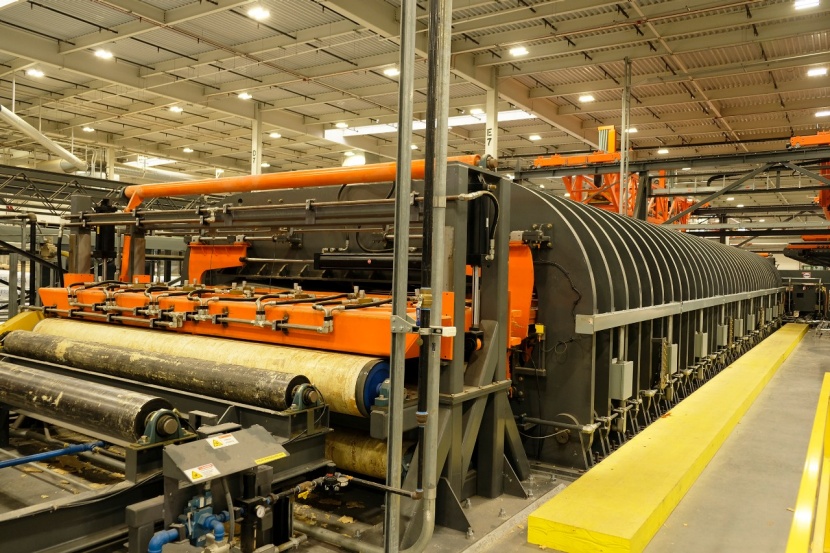
With the pneumatic press, panel sizes of up to 3.6 by 18.3 meters are possible © Raphael Kerschbaumer
After finger-jointing and planing, the lamellas enter the heart of the production. A vacuum crane is used to load the lay-up table with the individual CLT layers piece by piece. Once the press cake is ready, the panel is automatically fed into the pneumatic press by USNR. "We have built many different presses in the past. Producing cross-laminated timber in these dimensions, however, initially posed a big challenge, even for us. For this reason, we are particularly proud that we were able to successfully implement the order," says Sampson. The press hoses filled with compressed air provide the necessary pressure of 1.3N/mm2.
Once pressed, the panels are also joined on-site for further use. Two portal processing machines from Biesse and another one from Hundegger combined with a sanding machine from Costa provide the final finish before shipping.


