
The Upper Bavaria-based construction timber sawmill has been owned and run by the family for four generations. Marinus Obermaier, who is the owner since 2017, is mainly responsible for production and optimization, while his father Matthias takes care of the office and sales and his 88-year-old grandfather is responsible for the log sorting. Each year, 3,000 m³ of 3a + softwood are processed into construction timber. The contract cutting of softwood and hardwood accounts for 600 m³ of this volume.
Focus on quality log wood
“We mainly process 21-meter-long spruce logs from BaySF forestry company Schliersee, and 20% from other local suppliers,” explains Marinus Obermaier. The sawmill uses its own Latschbacher tags with different colors and a numerical code which indicate exactly when the log was cut and from which area and altitude it came. “We attach great importance to high quality and we don’t buy any damaged wood. In 2020, we paid €101/m³ for mountain log wood with its narrow annual rings,” explains Obermaier. Carpentry and timber construction companies are the main customers. With six employees, the sawmill generates sales worth around € 1 million, a third of which through trade.
Obermaier junior took over the business after completing his training as sawmill foreman and technical business economist at the Lehrinstitut Rosenheim and also completed advanced training courses as a PLC specialist and a Java programmer at the German Chambers of Industry and Commerce and the Chamber of Crafts. Obermaier is heavily involved in the optimization of cutting, image processing and the automatic turning of the logs at the EWD sash gang.


Increasing the added value
At the end of 2018, the decision was made to extend the company’s value chain. There were four options: the automation of the log yard, the investment in a trimmer, the creation of an own solid structural timber (KVH) production or the purchase of a joinery machine.
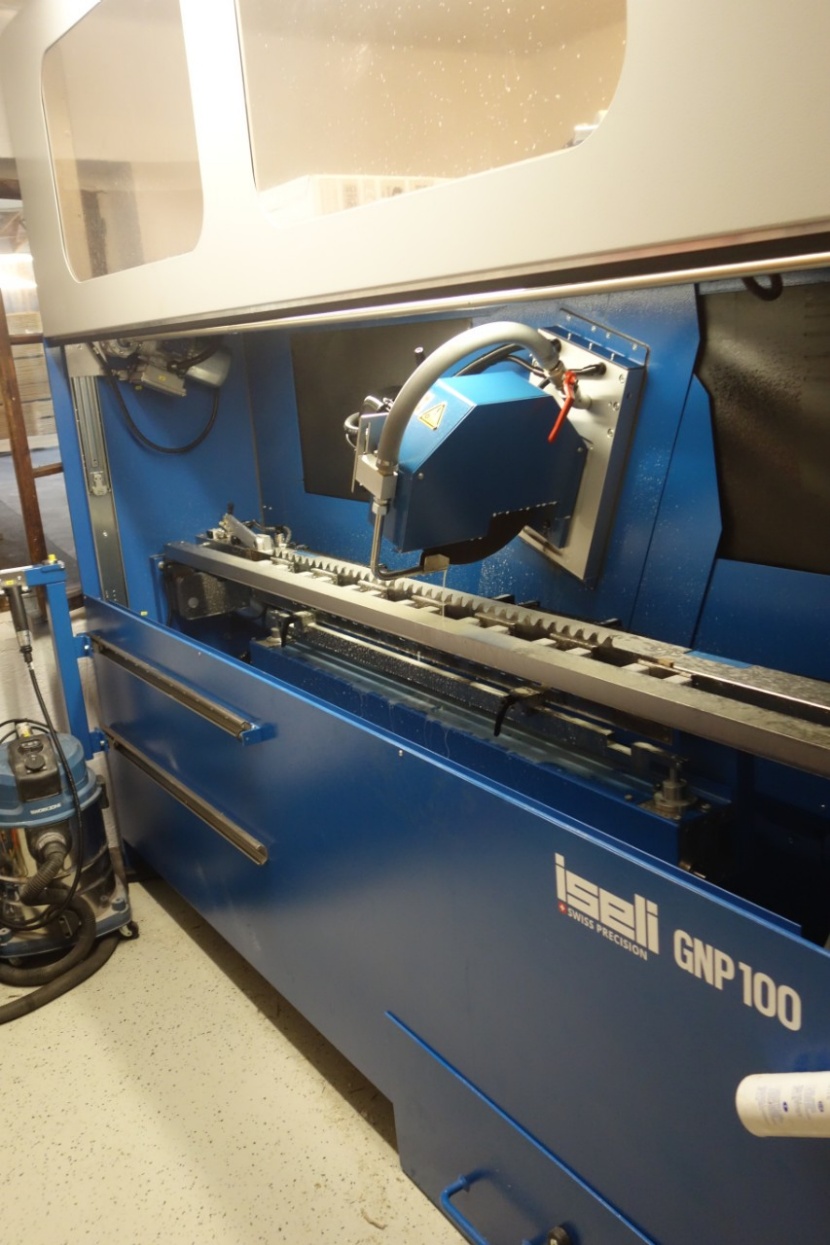
In the end, Obermaier opted for a Hundegger K2-Industry joinery machine. The machine, which is the first in the Tegernsee area, was delivered before Easter. “The capacity utilization of the sawmill is simply better and Hundegger has an excellent price-performance ratio and very good service. We can use a lot of stocked wood and control the optimization,” explains Obermaier. The lead time from producing to drying classic construction timber is three to four weeks. “For now, the machine just has to run and cover the variable costs,” adds Matthias Obermaier. Since December 2020, an Iseli GNP-100 profile sharpening machine has been in operation as well.
The automation of the log yard is still a possible project for the future, as it saves the sawmill €10 to €15/m³. “The main argument against having our own KVH production was that it doesn’t improve the capacity utilization of the sawmill, since it’s cheaper for a company of our size to buy the raw wood instead of cutting it ourselves. Furthermore, neither KVH producers nor raw wood suppliers have made any money in the past few years,” points out Matthias Obermaier. “The investment in a trimmer would reduce cutting and personnel costs and increase cutting, but we wouldn’t sell more,” explains Obermaier.
The company is very satisfied with the VDS-approved Pyrosmart fire detection system from Orglmeister Infrarot Systeme, for which the sawmill is a reference company. The system uses a video and infrared camera to measure the surface temperature of objects. When the temperature rises above a predefined threshold within the monitored area, the alarm is triggered. According to the manufacturer, the infrared technology detects fires at an early stage and prevents damage caused by false alarms.
US prices dominate the market
“Price lists for construction timber used to be valid for three years. Now, we have to change the prices every eight days. The KVH price determines the construction timber price and for loads of 10, 12 and 14 cm KVH, up to €580/m³ are charged. Fresh construction timber currently costs €350 to €400/m³, and you have to pay €200 to €250/m³ for sideboards,” tells us Matthias Obermaier. The log price also rises by around 8% each month. The situation is even more extreme when it comes to the price of CE roof battens, which has hardly changed in the past ten years. Then, in December, roof battens cost already €350/m³ and in early to mid-March, their price already reached €500/m³. “When the big industry charges €500 or more for roof battens, we have to do that, too. Otherwise, everyone will want to buy from us and stock up cheaply on their annual demand. In the past, the price of 3/5 battens ranged from €0.42 to €0.44 per running meter. Now, you have to pay up to one euro,” explains Obermaier.
“A lot is exported to the US. Demand for roof battens has remained the same, but there is a decrease in supply. The raw wood is delivered and remains on site when the US price is paid – even with moderate delivery times,” Matthias Obermaier is certain. “Other raw materials are also seeing big price increases. These are all harbingers of a coming inflation,” adds his son.
“After the boom, there is going to be a shakeout in the sawmill industry, especially when it comes to construction timber. The central question will be who invested in the added value of their own business in the past few years and who didn’t or didn’t invest enough”, emphasizes his father in conclusion.
Sägewerk Martin Obermaier
Location: Irschenberg, DE
Founded in: 1932
Owner: Marinus Obermaier
Staff: 6
Products: construction timber, contract cutting, joining (since 2021)
Purchasing: 3,000 m³ of spruce/fir, 21 m, 3a+
Sales: around € 1 million (2020)


