
Up until two years ago, Novalegno used to process almost 20,000 m³/year of softwood lumber into semi-finished finger-jointed products for the furniture, door and molding industry at its production site in Ampezzo/IT. “A few years ago, we were at a crossroads. We had to decide whether to continue as before or dare to take the step towards a significant expansion of our production,” Antonio D’Ambros, founder and senior partner of Novalegno, tells us. When his son Federico took the helm three years ago, the decision was made to invest. In 2020, Novalegno moved a large part of its production to Amaro, before starting it up in 2021. Since then, the company has been using the Ampezzo site primarily as a storage area and also operates a press there.
Trust, good communication and support
“At first, the idea was to only have a single-shift operation in Amaro instead of the two shifts we had before. However, demand has been increasing so sharply that we will probably introduce a third shift soon – despite output being significantly higher already,” Federico D’Ambros says with a smile. Novalegno currently processes around 55,000 m³ of raw wood. There were several reasons why the company chose Weinig and its two subsidiaries Weinig Dimter and Weinig Grecon as suppliers of the planers, cross-cutting saws and finger-jointing machines. On the one hand, Novalegno has been working with Weinig since the 1990s and has always had positive experience with their machines. “Weinig’s branch in Italy is a big advantage for us. It further improved communication,” Antonio D’Ambros says, referring to the establishment of Weinig Holz-Her Italia in Bolzano/IT. “Weinig also took all of our needs and requirements into account in the sales process and supported us very well in carrying out the project,” Federico D’Ambros adds.


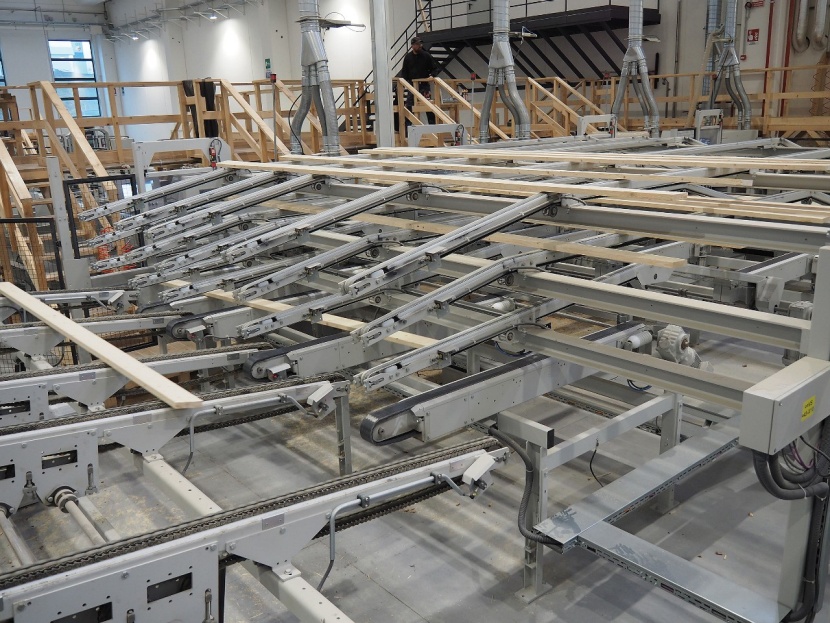
Weinig delivered the entire line including the mechanization. It processes wood with initial lengths of 3 to 5.2 meters and is designed for widths of 50 to 210 mm and thicknesses of 20 to 70 mm. The cross-sections of the finished product range from 20 x 20 mm to 65 x 160 mm according to Federico D’Ambros. “Our range of products includes around 300 different dimensions – which we manufacture exclusively on customer request and based on the respective order”, the managing director tells us. In order of their use in Novalegno’s production site, Weinig delivered the following machines and systems: Everything starts with a tilt de-stacking device for the raw wood and the crosswise transport towards the first station where the lumber is assessed by an employee. After the front side is cut, a scanner determines the direction of the wood fibers. “If a board is not positioned correctly, it is turned automatically,” Rudolf Markt, Area Sales Manager at Weinig Holz-Her Italia, explains. Using the SF 200 device, the lumber is then pulled into the Hydromat 4200 planing machine, which is equipped with four spindles (two of which are floating spindles) for pre-planing and achieves feed rates of up to 200 m/min.
Up to 50 boards per minute
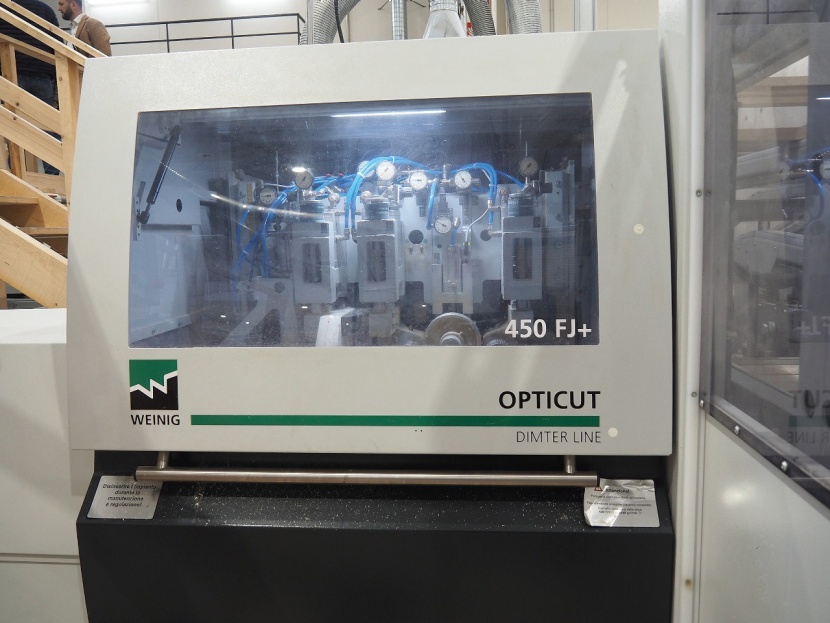
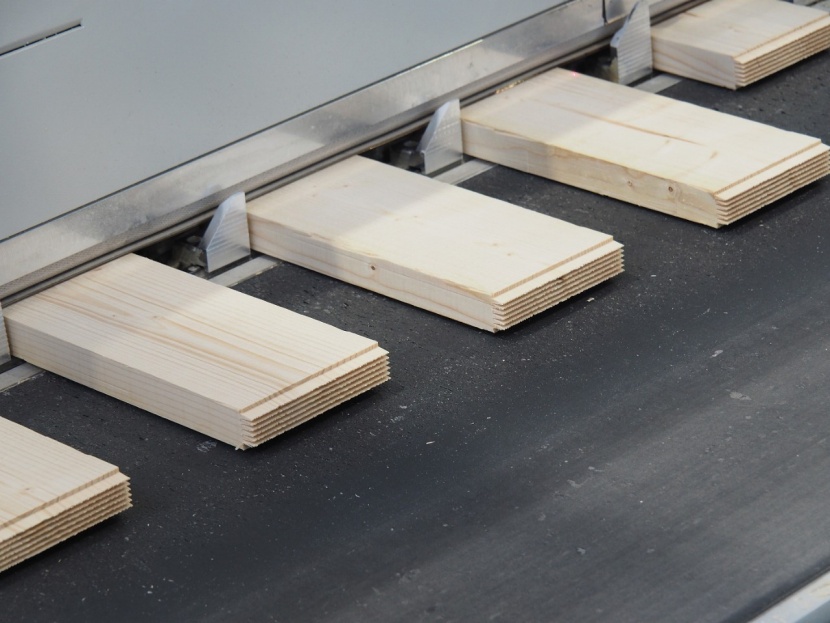
Next, the boards are transported to the scanner on a crosswise buffer conveyor and positioned longitudinally before they enter it. The scanner detects undesirable wood characteristics and forwards the results to the four Weinig Dimter OptiCut 450 FJ+ cross-cutting saws. “The Weinig control system handles the allocation to the cross-cutting saws, which request the boards depending on their level of utilization and availability,” Peter Braun, Regional Sales Manager at Weinig Dimter in Italy, explains. A device distributes the layers of a lumber package among the respective cross-cutting saws. “The entire cross-cutting line can reach a maximum output of 50 boards per minute, depending on the quality of the wood and the average length of the finger-jointed pieces,” Federico D’Ambros adds. The four identical OptiCut 450 FJ+ are equipped with an automatic waste chute. The cross-cut wood is sorted into five qualities, all of which are then processed in the two Weinig Grecon HS 200 finger-jointing lines. Each of them is designed for an output of up to eleven cycles or 200 pieces per minute with an average length of 350 mm. The finger-jointed timber is then pressed, cross-cut and planed.
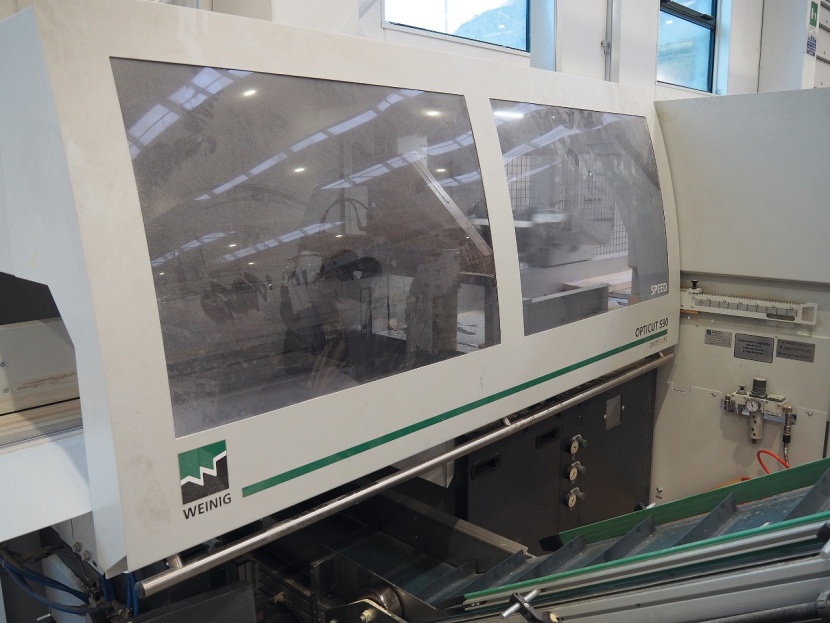
Weinig Dimter also delivered an OptiCut S90 Speed, which Novalegno uses mainly for the processing of a second quality, for special customer requirements and order picking. “The machine is equipped with a crosswise chain feed and an automatic waste chute,” Braun explains. The OptiCut S90 Speed is designed for lumber with initial lengths of 0.9 to 6.3 meters and cross-sections of 40 x 15 mm to 230 x 15 mm or 110 x 110 mm. After cross-cutting, the pieces have fixed lengths of 80 mm.
The expansion of production not only resulted in a significantly higher output. The company’s sales channels have changed as well. Novalegno now exports 80% of its products to four continents. Further investments are to be made in the near future: This year, Weinig will install a Hydromat, which should increase output substantially. In the coming years, he would also like to expand the company’s portfolio. In order to make the best use of the wood, the managing director is thinking of producing single-layer solid wood panels. The aim is to increase production by 20 to 25% by 2024.
Novalegno
Established in: 1982
Production sites: Padola/IT (1), Ampezzo/IT (2), Amaro/IT (3)
Managing director: Federico D’Ambros
Sales: €21 million in 2022 (2020: €7 million)
Staff: 40
Processing: 55,000 m³/year, mostly spruce
Products: semi-finished finger-jointed products for the furniture, door and molding industry, façades
Share of exports: 80% worldwide


