
The pre-mounted connectors were installed on site from a lifting platform. Scaffolding was not necessary © Lignotrend
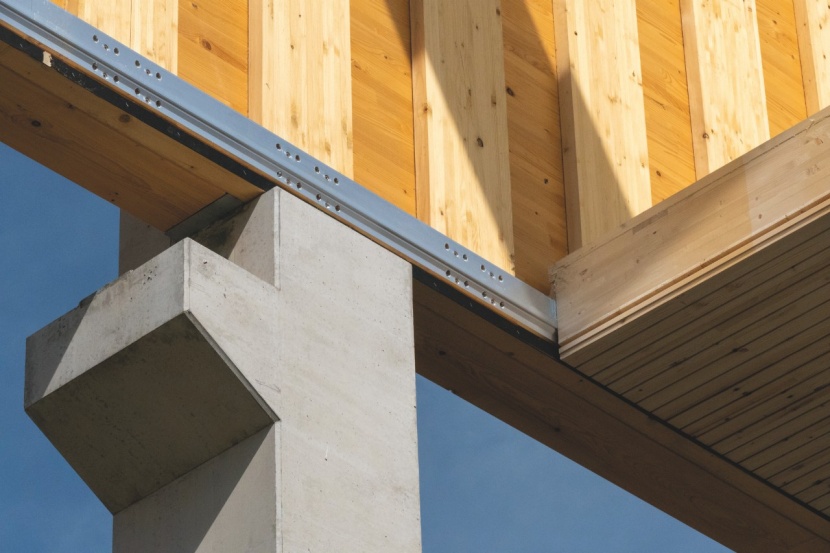
In order to make the sawmill hall wider, its gable roof was extended at the eaves and a building with a flat roof was added to the extended gable roof trusses. Due to the limited height of the hall, the flat roof elements made of cross-laminated timber had to be connected directly to the gable roof trusses. Precisely for this application, Knapp of Euratsfeld developed, in close collaboration with Lignotrend, the Evo Grip, a two-part connector with variable width. With this product, classic beam connections (with a minimum connector width of 60 mm) as well as wide ceiling-to-wall connections are possible with the same profile cross-section. A special feature of the connector is the ribbed design on the back, which is pressed into the wood through the 45-degree screw connections, thereby significantly increasing grip and, as a result, the load-bearing capacity of the connection.
With the connector rail, CLT elements can be slid laterally into the tongue-and-groove joint – which is ideal for multi-story buildings where ceilings connect with continuous walls. This eliminates the need for decoupling and conventional support systems and makes connections much easier © Knapp
The new Evo Grip connector plate was slid horizontally and at a 90° angle to the element tension direction of the Lignotrend elements with their tongue-and-groove connection and now ensures stress-free support.
The first part of the connector plate was attached to the sides of the gable roof trusses, and the second one to the end faces of the cross-laminated timber elements. A projection of around 2 cm on the top of the elements served as a stop for screwing. Graphite strips were inserted in the space between the structures for additional fire safety.
Lighter, faster and without scaffolding

With the connector plate, it is possible to slide the Lignotrend CLT elements laterally into the tongue-and-groove joint. This is especially important in complex construction projects involving continuous walls, for example elevator shafts with continuous CLT walls, or multi-story buildings such as schools or residential buildings where ceilings connect to continuous walls © Knapp GmbH
The chosen solution offers several advantages. “The uncomplicated cross-laminated timber detail facilitated joining. Installation was easier, faster, and could be done without scaffolding. And once installed, the suspension connector also eliminates potential transverse compression,” Alexander Villinger, who was responsible for the expansion of the sawmill hall, says. Reason enough for Lignotrend to use the Evo Grip profile version more frequently in the future: “With this connector plate, we can slide our cross-laminated timber elements laterally into the tongue and groove joint,” the trained carpenter and timber engineer adds. “This is especially important in complex construction projects involving continuous walls, for example elevator shafts with continuous cross-laminated timber walls, or multi-story buildings such as schools or residential buildings where ceilings connect to continuous walls. For connections like these, the elements previously had to be decoupled at the bottom and supported conventionally. The Evo Grip connector makes these connections much easier.”


