
© Timber-Online
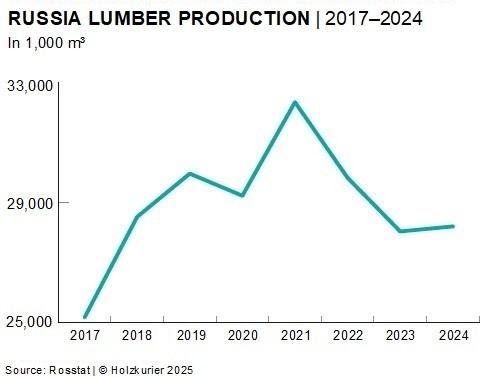
Last year, Russian lumber production output amounted to 28.2 million m³ and was thus slightly higher than in 2023. It was also the first year-on-year increase since 2021. After reaching an eight-year high of 32.4 million m³ in 2021, production decreased in both 2022 (-8% to 29.8 million m³) and 2023 (-6% to 28 million m³). Especially in the first half of 2024, the Russian Federal Statistics Service recorded significant monthly growth rates of up to 17% – a dynamic that was not sustained in the second half of the year.
At 2 million m³ and 2.3 million m³, respectively, lumber production in January and February was slightly below the levels of the same respective months of 2018, according to Rosstat figures. Softwood lumber accounted for over 90% of the production output.
Losses despite growing revenue

© Timber-Online
After Russian lumber producers had seen their revenues fall by 9% in 2022 and by 21% in 2023, they recorded a 16% increase last year, which brought the total to RUB 273.5 billion (€2.7 billion). In 2021, revenues of RUB 286 billion (€3.3 billion) were recorded, the highest level in the past eight years.

© Timber-Online
The development of Russian lumber producers’ profits was significantly more striking than the revenue trend. According to the Russian Federal Statistics Service (Rosstat), profits amounted to RUB 78.5 billion (€900.5 million) in 2021. In the following year, they fell by almost 90% to RUB 8.3 billion (€111.9 million), with companies reporting losses of RUB 16.9 billion (€229.3 million) in the second half of 2022.
This downward trend continued into the following year, and losses totaled RUB 4.1 billion (€44 million) in 2023. In the fourth quarter of 2023, lumber producers reported net profits for the first time since the summer of 2022. Last year, Russian lumber producers’ operating results improved, but they nevertheless posted a total loss of RUB 600 million (€6.2 million) at the end of the year. (Editor’s note: The average exchange rate for the respective year was used for the conversion.)
Where is Russia’s lumber going?
© Timber-Online
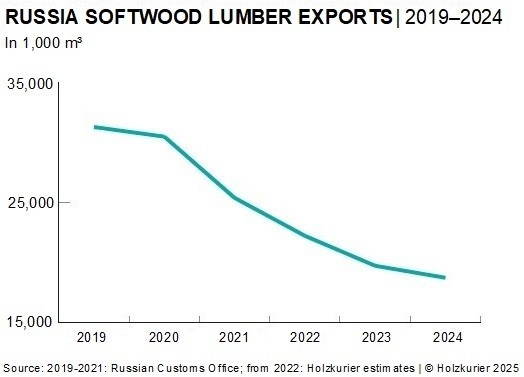
According to Holzkurier estimates, a total of 18.7 million m³ of softwood lumber was exported from Russia in 2024. This represents a 5% decrease compared to 2023. Since 2019, Russian lumber exports have declined by 40%. China, whose imports amounted to 11.2 million m³ in 2024, accounts for around 60% of Russian exports. Uzbekistan is another major buyer and received over 10% of exports. According to Holzkurier estimates, Russia exported 1.7 million m³ of softwood lumber to the MENA region in 2024, with Egypt being the largest trading partner in North Africa and the Middle East with 550,000 m³. A similar amount was likely delivered to Iran.
According to figures published by Roslesinforg, there was also an increase in trade with Turkey last year. This was partly due to reconstruction efforts following two devastating earthquakes in the southeast of the country in 2023.
On the other hand, there are numerous reports that Russian wood products are being imported into the EU via third countries despite the sanctions. In a recently published market analysis, WWF Germany, for example, criticized the fact that significant quantities of Russian wood products are still available in Germany. The British NGO Earthsight estimates that wood and wood products worth €1.5 billion have been illegally imported into the EU via third countries since the embargo has been in place.


